Most people do not abandon a budgeting method because they lack discipline. They abandon it because the method was built for a paycheque that behaves: one fixed sum, arriving on the same day, every month, and few paycheques actually do.
Three things tend to break a new budget within weeks. The first is treating it like a diet, a system so strict that the smallest indulgence feels like failure, and failure breeds quitting. The second is friction: methods that demand a log of every coffee and bus fare collapse under their own paperwork. The third, and the one people see coming least, is the irregular expense, the car registration, the holiday gifts, the annual insurance bill that lands in October and undoes five months of careful tracking.
There is a difference between watching where money went and deciding where it will go. Expense tracking looks backward. It is a record of regret, useful mainly for diagnosing a problem after the damage is done. A budgeting system looks forward; it assigns a job to every dollar before the month begins, which is also why it survives contact with real life in a way a backward-looking ledger cannot.
A method that lasts shares three traits. It can absorb a shock, a flat tyre, a dental bill, a wedding invitation, without forcing a total rewrite. It automates the boring parts, so saving and bill payment happen without a daily act of will. And it matches how its user actually relates to money: some people need to feel cash leave their hands to believe it is gone, others need it to vanish from view before they are tempted to spend it.
The tools have changed faster than the underlying choice. Budgeting apps in 2025 sort transactions into categories with little manual correction needed, flag a low-cash week before it arrives, and sync chequing, savings and investment accounts in real time through open banking. None of that answers the prior question, though: which structure should the software actually enforce? That decision still belongs to the person holding the account, not the program reading it.
Monthly upkeep, by budgeting method
Estimated time to maintain each system once it is set up, not counting the hours spent building it.
Why most budgets do not survive the month
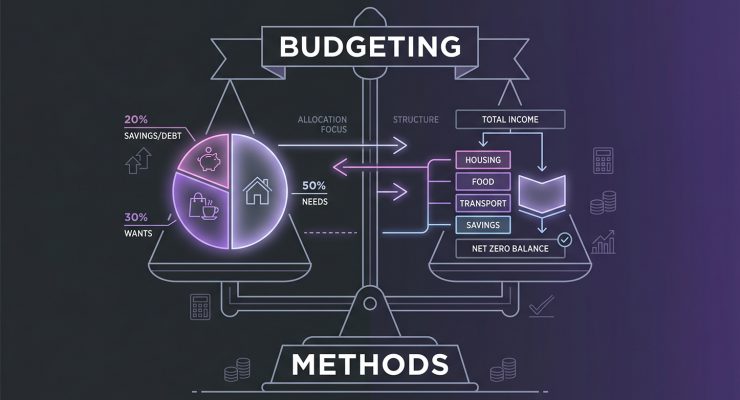
Strip away the branding and most personal budgets reduce to four designs. The 50/30/20 rule sorts spending into three broad percentages and lets the rest take care of itself. Zero-based budgeting assigns every dollar a purpose before it is spent. The envelope system draws hard boundaries, physical or digital, around categories that tend to run wild. Pay-yourself-first budgeting automates the saving and ignores everything else. Each trades simplicity for control in a different place, and the trade a person can tolerate says more about which method will survive than any productivity advice ever could.
The four systems differ less in goal than in how much daily attention they demand, as the comparison below shows.
| Method | Monthly time | Best suited for | Handles irregular income |
|---|---|---|---|
| 50/30/20 rule | 1 to 2 hours | Beginners with stable salaries | Only with adjusted percentages |
| Zero-based budgeting | 4 to 6 hours | Detail-oriented planners and debt payoff | Yes, by design |
| Envelope system | 2 to 3 hours | Chronic overspenders and tactile spenders | Moderately, with a fill-priority list |
| Pay yourself first | Under 1 hour | Hands-off savers with steady income | Only if transfers are set as percentages |
The most forgiving place to start is also the most popular.
The 50/30/20 rule: easy maths, real limits
The arithmetic is deliberately blunt. Half of take-home pay covers needs: rent, groceries, utilities, transport, the minimum on any debt. Three-tenths goes to wants: meals out, subscriptions, travel, the nicer version of things the needs category would buy more cheaply. The final fifth is reserved for the future, split between an emergency fund, retirement contributions and any extra debt principal a person can spare.
Run the numbers on a $4,000 monthly income and the appeal becomes obvious. Two thousand dollars covers rent of $1,400, groceries of $400 and utilities of $200. Twelve hundred dollars stretches across dining out, a gym membership, streaming subscriptions and a travel fund. The remaining $800 splits between a Roth IRA contribution and a high-yield savings account, with no spreadsheet of forty categories required.
Where a $4,000 paycheque goes under the 50/30/20 rule
Its appeal is structural. Three buckets are easy to remember and even easier to automate, and the 30% allocated to wants gives permission to enjoy the present without derailing the future, a release valve that more rigid systems often lack.
Yet the rule assumes a kind of average life that is getting rarer. In expensive cities, rent alone can swallow 40 to 50% of take-home pay, leaving nothing for the rest of the needs category before a single grocery bill arrives. Households carrying heavy debt find that 20% barely makes a dent, while annual costs, insurance, registration, holiday spending, blow straight through percentages calculated on a single month’s view.
Freelancers and commissioned workers can still use the framework, but only after bending it. One option is to calculate the percentages against the worst month of the previous year, treating anything above that as a bonus rather than a baseline. Another is to let the splits move with the season, 60/20/20 in a lean month, 45/35/20 in a flush one, and use the gap between them to fill a holding account that smooths out the difference.
Zero-based budgeting: total control, at a cost
Where the 50/30/20 rule paints in broad strokes, zero-based budgeting accounts for every brushstroke. Each dollar of income is assigned to a category before the month starts, and the goal is for income minus allocations to equal exactly zero, not because the bank account hits zero, but because no money is left without a job.
A household earning $5,000 might assign $1,800 to rent, $500 to groceries, $700 to an emergency fund, $500 to a Roth IRA, $300 to utilities, $400 to dining out, $400 to a car payment and $400 to entertainment. Add it up and the total lands precisely on $5,000. Nothing drifts, because nothing is allowed to.
The discipline this enforces is its own reward. Small, unaccounted purchases, the so-called leaky bucket that quietly drains a household’s wealth, become almost impossible to ignore. But the same precision is the method’s biggest cost: building the initial map of categories takes hours, and keeping it accurate demands a weekly, sometimes daily, habit of moving funds around the moment one category runs over.
The same logic underpins a plan to clear $50,000 in consumer debt within three years: assign the surplus before it can be spent, and the balance shrinks on a schedule rather than by accident.
For irregular earners, zero-based budgeting flips the question. Instead of forecasting a paycheque that has not arrived, it asks only what the money already sitting in the account needs to do before the next one does. Survival categories, food, shelter, utilities, fill first; discretionary ones fill only once cash is actually in hand; and anything left over from a strong month funds a “next month’s income” category that absorbs the following slow one.
Envelopes and automation: two opposite philosophies
The envelope system solves a different problem: not how to plan spending, but how to stop it. Cash, or its digital equivalent, is loaded into category-specific envelopes at the start of each cycle, and once an envelope is empty, spending in that category stops. Not as a suggestion. As a fact.
Physical cash carries a psychological weight that a balance on a screen does not. Handing over paper money to buy something stings in a way that tapping a card never quite manages, which is precisely the point for someone trying to break a habit. Digital envelopes trade that friction for convenience and safety, working through virtual sub-accounts that operate online and cannot be lost to a stolen wallet.
Chronic overspenders and people who think in concrete, visual terms tend to benefit most; those who pay for everything by card and value rewards points tend to find the system clumsy. The trade is stark: hard limits eliminate overdraft fees and impulse purchases, at the cost of convenience and any cashback a card might have offered.
Pay-yourself-first budgeting, sometimes called reverse budgeting, inverts the entire premise. The first transaction after each paycheque lands is a transfer to savings, investments or debt; whatever remains in the chequing account can be spent without a second thought, down to zero, with no category tracking at all.
How pay-yourself-first automation works
The paycheque lands in the chequing account
An automatic transfer fires that same day, before any spending happens
Savings, investments or debt principal get funded first, with no decision required
Whatever is left can be spent freely, down to zero, with no category tracking at all
Automating that first transfer is also the surest route to a cash reserve, and a six-month roadmap for building an emergency fund from scratch runs on much the same logic: move the money before it can be spent, and the habit does the rest.
The appeal is that it removes willpower from the equation entirely. Money that disappears before it ever shows up in a chequing balance does not have to be defended against each evening; the lifestyle simply adjusts to what is left. The risk runs the other way: a single unstable month can trigger an overdraft, and the method does nothing to curb the daily habits that caused it. For variable earners, the fix is to automate a percentage rather than a fixed sum, so the transfer shrinks along with a leaner month instead of emptying an account that was never going to hold $1,000 in the first place.
Software cannot pick a philosophy, but it can make one easier to keep, and the table below pairs five leading apps with the budgeting method each was built to support.
| App | Suits best | Approx. price | Ideal user |
|---|---|---|---|
| YNAB | Zero-based budgeting | Around $15 a month | Anyone breaking a paycheque to paycheque cycle |
| EveryDollar | Zero-based budgeting | Free, or about $80 a year | Beginners focused on debt elimination |
| Simplifi | 50/30/20 rule | About $4 to $6 a month | Hands-off trackers who want broad targets |
| Goodbudget | Envelope system | Free tier, or about $8 a month | Couples who want shared digital envelopes |
| Empower | Pay yourself first | Free | High earners focused on net worth, not categories |
Choosing a budgeting method when income isn’t steady
Freelance, commission and seasonal income turn ordinary budgeting advice on its head. A graphic designer might clear $8,000 one month and $3,000 the next, a swing that breeds either panic spending in the good months or panic freezing in the lean ones. Worse, the tax bill that a salaried worker never has to think about, the 25 to 30% that should be set aside for quarterly payments, becomes the single most common way a variable income turns into a crisis.
The fix is to budget against the floor, not the average. Building a baseline budget around the worst realistic month, and treating anything earned above it as a bonus to be saved or invested, removes the guesswork that turns a good month into an overspent one. The more ambitious version of the same idea is the buffer month: building up roughly one month of expenses in reserve so that today’s bills are paid with money earned thirty days ago, which turns an erratic income into something that behaves like a salary.
Of the four systems, zero-based budgeting suits this kind of life best, because it never asks anyone to forecast money that has not yet arrived. A 50/30/20 framework can be made to work if its percentages are recalculated against a rolling twelve-month average. A hybrid, zero-based discipline applied inside digital envelopes, gives variable earners both the precision to track every dollar and the hard limits to stop a good month from being spent twice over.
The method that wins is the one still running in December
Building a buffer month: six months off the feast-or-famine cycle
None of these systems is intrinsically better; each is a bet on a particular kind of life. A salaried manager earning a predictable $6,000 a month has little reason to wrestle with zero-based budgeting’s daily reshuffling when 50/30/20 can automate the same outcome for a fraction of the effort. A chronic overspender has little use for pay-yourself-first’s hands-off philosophy, because the problem was never the saving, it was the spending that came after. And an investor already routing 40% of every paycheque into index funds on autopilot does not need forty categories to feel in control; the goal that matters most is already locked in before the month begins.
The newest apps blur these lines further still, layering smarter categorisation and cash-flow warnings over whichever structure a household chooses. But software was never the part that failed. What fails is the system that cannot survive an irregular paycheque, an unexpected bill, or an ordinary Tuesday night, and the budgeting method worth keeping is simply the one still running, unbothered, when December’s bills land on top of everything else.