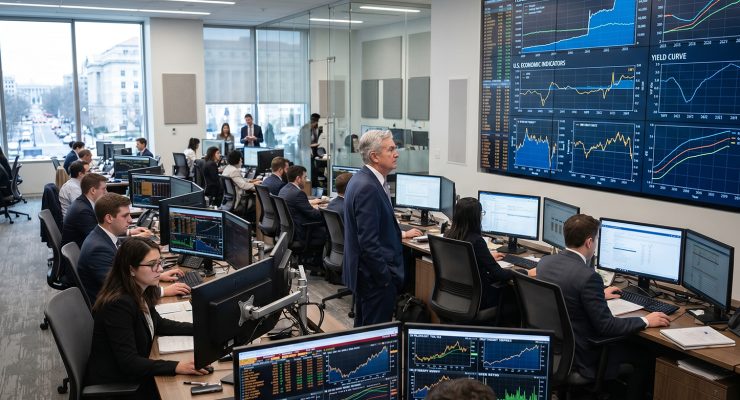
The Federal Reserve’s balance sheet is no longer an instrument of policy. After nearly fifteen years of expansion from approximately $900bn prior to 2008 financial crisis to a peak of $8.9trn in April 2022, its growth has become more of an infrastructure than an instrument. Kevin Warsh, who is often mentioned as potential successor for Jerome Powell as governor, recognizes this. His advocacy for more restrained central banking goes beyond interest rates or inflation targets: it relates more directly to whether it should step back from an expansive role it was never supposed to occupy permanently.
Problematic for any system is when its components can no longer function without each other.
Balance Sheet as Load-Bearing Wall
After the 2008 financial crisis, the Fed used quantitative easing to expand their balance sheet through quantitative easing, purchasing Treasury bonds and mortgage-backed securities to push long-term interest rates lower and stabilise markets. Although intended as temporary, crisis-era measures; their balance sheets never returned to pre-crisis levels before another crisis hit; by 2020 when pandemic hit, quantitative easing had expanded yet further, adding over $4.8trn worth of assets in two years!
Changed not only was the size but the composition of balance sheets: banks, money market funds and other financial intermediaries had to adapt their operations in light of ample reserves provided by the Fed – once seen as lender of last resort but now acting as permanent backstop – which had become their financial backstop and provider of first resort relief.
The Plumbing Problem
Perhaps the most revealing moment came not at a press conference but in a repo market on a Tuesday in September 2019. On September 17th of that year, overnight repurchase agreement rates spiked nearly eight times higher than the prevailing federal funds rate due to reserve scarcity colliding with seasonal tax payments and an unexpected Treasury settlement. In response, the Fed provided $53bn overnight in repo operations and then increased it over subsequent days by hundreds of billions more.
The episode was instructive for two reasons. First, it demonstrated that even with a balance sheet of $3.8trn, the system was closer to collapse than many participants expected. Second, it led the Federal Reserve to create the Standing Repo Facility – an on-demand liquidity backstop designed to prevent another such crisis from arising again – in July 2021 as a permanent and on-demand liquidity backstop designed to prevent another repeat – thus offering stability-reducing solutions by making more reliable availability of Fed funds.
Dependency dynamics at play! Each intervention teaches the system to anticipate its next one.
What Are Warsh’s Proposals
Mr Warsh’s critique of the modern Fed is not limited to just its federal funds rate level; rather it concerns its footprint: assets held, sectors supported implicitly and expectations created that monetary policy will always subordinate itself to financial stability when conflict arises.
Since his departure from the Fed’s board in 2011, Bernanke has articulated an argument in numerous speeches and written commentary that contends monetary policy has devolved into credit allocation: selecting which asset classes benefit from being supported and which do not. A truly restrained Fed would reduce its balance sheet materially while restricting asset purchases only for acute emergencies and reinstating price mechanism in money markets.
Question is not whether this arrangement is ideal in the long-run; it likely is; question is if transition can be managed efficiently.
Cold Turkey and Its Risks
Quantitative tightening, or the Fed’s ongoing reduction of its balance sheet by allowing maturing bonds to roll off, has already put strain on the system’s resilience. From April 2022 until mid-2024, roughly $1.7trn was subtracted from their balance sheet through this means. Luckily, however, this reduction was relatively orderly because both it was done deliberately by the Federal Reserve as well as because banks had built up significant excess reserves during pandemic expansion.
But the gap between “orderly so far” and “structurally independent” can be substantial, with repo market stress appearing quickly – as evidenced by its 2019 episode unfolding within one session – and structural independence can be wide. According to research done by the Federal Reserve itself, it appears difficult to identify an optimal level of reserves – the “ample reserves threshold – in advance; its true nature tends to only become evident once already reached.
An aggressive balance sheet reduction undertaken on principle rather than gradually could recreate 2019 conditions. While the Standing Repo Facility provides some support, its existence only further confirms this paradox: the Fed cannot credibly exit their market-support role while maintaining facilities designed to mitigate any associated consequences of doing so.
Restraint Policy and Its Political Economic Implications (PDF).
Political durability must also be considered: under a Mr Warsh presidency, the Fed would inherit an institution whose credibility depends on market trust in its willingness to intervene. Any indication from its new leadership that plans a sharper withdrawal are being considered may cause longer-dated yields to rise and tighten financial conditions before formal policy action has even taken place – markets don’t wait for announcements but price intentions instead.
The Federal Reserve’s balance sheet is more than an economic variable; it serves as a signal about its responsibilities to financial system participants. Altering this signal constitutes renegotiation of an implicit contract between it and financial systems; markets can handle changes to policies; however, they often resist changes to rules of the game.
Regime Change that Matters
No matter who holds the chairmanship, Mr Warsh’s point about tension is accurate: the Federal Reserve has expanded its role beyond what may have been intended temporarily and requires careful sequence, sustained transparency, and considerable patience from a political class that has come to expect quick solutions from them.
Risk lies not with any attempt by the Federal Reserve to withdraw, but in that after fifteen years of permanent intervention markets have forgotten how to price money without intervention from outside sources. Witnessing what this experiment will reveal. #