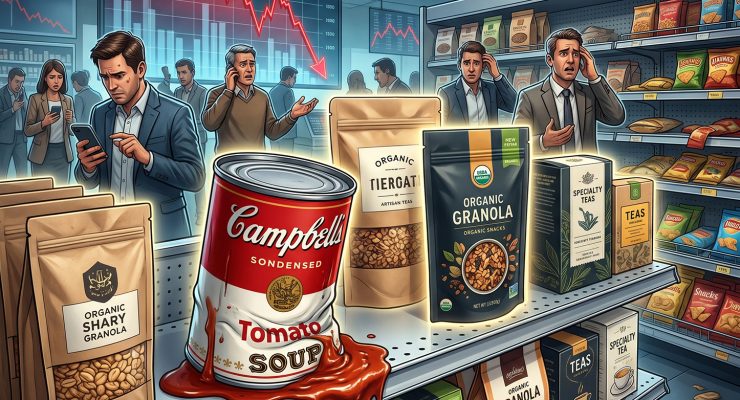
Campbell Soup Company’s stock has retreated to levels not seen since the early 1990s, and the cause is not a supply chain disruption or a commodity spike. It is structural. The consumers who built Campbell’s into one of America’s most recognised food brands have quietly stopped buying on habit. They now buy on identity, on health alignment, and on what a product says about them as people. Legacy convenience brands are losing that competition, and the CPB chart is one of the clearest measures of how badly. The stock’s decline is not a Campbell’s story. It is a consumer behavior story with implications for every food company that built its business on mass-market shelf presence.
A 30-Year Stock Low Is the Market Pricing in a Structural Question
When a stock retreats to its lowest level in three decades, the market is not reacting to a bad quarter. It is pricing in a durable question about the underlying business model.
Campbell’s has faced persistent pressure across its core segments. Its traditional soup lines, the products most closely associated with the brand, have struggled to grow organically as consumers reach past familiar cans in favour of options that feel more contemporary, more nutritious, or more aligned with their identity. The snack portfolio, acquired to diversify revenue, has delivered mixed results.
The tension is visible in the company’s recent financial results: net sales growth has been driven largely by acquisitions rather than by organic demand for legacy products. That is a warning sign. It means the underlying consumer relationship with the historic Campbell’s portfolio is weakening even as management engineers top-line figures through deals.
What Consumers Are Actually Buying Now
The shift in food purchasing behavior over the past decade has been well-documented by market research firms including Euromonitor and McKinsey. Consumers are not simply choosing healthier products. They are choosing products that communicate something about who they are.
This matters for Campbell’s because convenience was the brand’s founding promise. The red-and-white can communicated ease, reliability, and familiarity. Those attributes carried enormous value in the mid-twentieth century. They carry considerably less in a market where consumers are willing to spend significantly more on a product that feels artisanal, transparent about ingredients, or associated with a cultural identity they want to signal.
Health positioning compounds the problem. Processed soups and crackers face increasing headwinds from consumers actively avoiding sodium, additives, and preservatives. Campbell’s has reformulated products and introduced lower-sodium lines, but reformulation has not reversed the trajectory. The brand association is difficult to shake even when the product has changed.
The Rao’s Acquisition: What Premium Success Actually Requires
Campbell’s acquisition of Sovos Brands, the parent company of Rao’s Homemade, for approximately $2.7 billion in 2023 was a direct acknowledgment of the problem. Rao’s had built a premium pasta sauce brand that commanded prices of roughly $10 to $12 per jar, three to four times the cost of a standard shelf option, and was growing at a rate the legacy portfolio could not approach.
The strategic logic was sound: buy into a brand that modern consumers actually want. But the acquisition also illustrated the limitation. Rao’s success was built on a specific identity, namely authentic Italian-American heritage, small-batch associations, and a perception of quality earned over decades before going mass-market. That perception is fragile and difficult to replicate at scale. Whether Campbell’s can grow Rao’s without eroding the authenticity that made it valuable is the central question the market is now pricing into CPB.
The contrast between Rao’s growth and the weakness in legacy products is not a coincidence. It is the same consumer making different choices: selecting the expensive jar of pasta sauce while bypassing the red-and-white can in the adjacent aisle. The fuller picture of this consumer behavior shift, visible across financial services and digital payments as well as consumer goods, is explored in our analysis of how infrastructure brands succeed by becoming invisible.
What This Means for Investors in CPB
Campbell’s is not facing existential collapse. The company generates substantial free cash flow from its legacy portfolio, the brands are deeply embedded in distribution infrastructure, and the Rao’s acquisition adds a genuinely high-growth asset to the mix.
The investment question is whether cash flows from legacy products will decline faster than Rao’s and other premium acquisitions can compensate. At a 30-year stock low, the market is skeptical that the math works in the near term.
For investors, the relevant comparison is not Campbell’s versus its historical self. It is Campbell’s versus the broader consumer-staples universe. Peers that made earlier pivots toward health positioning or premium private-label competition offer a range of outcomes that suggests there is no straightforward formula for legacy brand turnaround. The consumer is not returning to convenience for its own sake. Any recovery in CPB requires either a credible reinvention of the core portfolio or a continued shift of revenue weight toward acquired premium brands. Neither is a fast process.
The Broader Signal for Consumer-Facing Companies
Campbell’s is not alone. The same dynamic is visible across legacy food categories: mass-market brands built on convenience and familiarity are seeing volume erosion as consumers segment toward either genuine premium or aggressively priced private label, bypassing the mid-market brands that defined post-war consumer spending.
The winners in this environment share a common attribute. They are brands that stand for something beyond function: Rao’s for Italian authenticity, Athletic Brewing for performance culture, Olipop for gut health and nostalgia without sugar. The attribute is emotional relevance, and it cannot be manufactured by a reformulation or a marketing campaign alone.
For companies managing legacy portfolios, the Campbell case is an unambiguous data point: brand equity built on convenience alone is depreciating. The consumers willing to pay a premium in 2025 are not paying for ease. They are paying for identity. The companies that understand the distinction before the stock chart forces the lesson are the ones most likely to avoid the same trajectory. ■