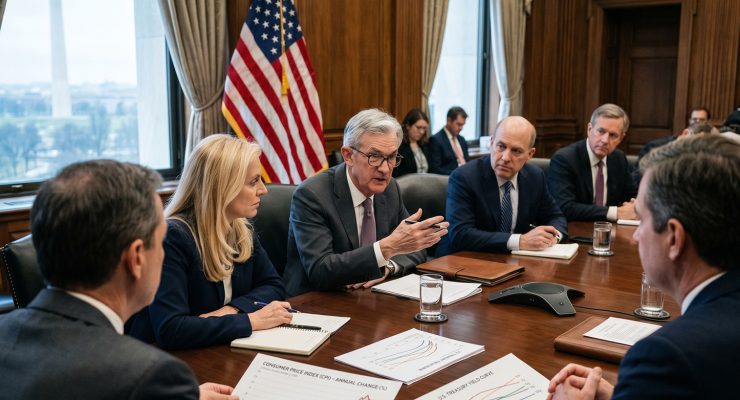
Credibility is the one asset a central bank cannot print.
For most of the post-war era, that observation was theoretical comfort rather than actionable concern. Yet throughout 2025, the debate over Federal Reserve independence moved from academic seminar to front-page market risk, forcing macro investors to confront a question that had long seemed settled: what happens to asset prices when markets begin doubting the Fed’s ability to act without political interference? The answer is not simply higher interest rates. It is a structural repricing of nearly every asset class simultaneously, as the discount rate for future corporate cash flows, the term premium on government bonds, and the risk premium on the US dollar all reset to reflect institutional uncertainty rather than economic fundamentals.
The Federal Reserve at a Glance
Source: Federal Reserve Board of Governors; Federal Reserve Act of 1913
What Does Federal Reserve Independence Actually Mean?
The Federal Reserve operates under a dual mandate: sustain price stability, defined as a 2% core inflation target over the long run, and maximise employment at the highest level the economy can sustain without triggering an acceleration of prices. These two goals frequently conflict. When the labour market runs hot, the Fed must cool it deliberately, accepting higher unemployment to prevent a wage-price spiral. That trade-off is only credible if markets believe the institution will follow through regardless of the political cost.
The Fed’s architecture was designed to make short-term political manipulation difficult. Seven Governors sit in Washington, appointed by the President and confirmed by the Senate to staggered 14-year terms, ensuring no single administration can clear the Board. Interest rate decisions rest with the Federal Open Market Committee, a 12-member body that includes those Governors, the president of the New York Fed, and four rotating regional bank presidents. Each member casts an equal vote; a single Chair cannot unilaterally force policy.
Independence, however, does not mean unaccountability. The Fed is a creature of Congress, created by the Federal Reserve Act of 1913, and Congress retains the theoretical power to rewrite that mandate. The Chair testifies before Congress twice a year. Meeting minutes are published on a three-week lag, and the quarterly “dot plot” of FOMC rate projections exposes the committee’s collective thinking to full public scrutiny. The institution operates within democratic oversight; it is simply insulated from the day-to-day pressures of the executive branch.
Why Central Bank Independence Matters for Inflation and Markets
The economic logic for keeping central bankers independent from politicians is well-documented and embarrassingly ignored in practice. Politicians prefer lower rates before elections. Cheap credit boosts short-term growth, inflates asset prices, and makes voters feel prosperous in the months that count. The problem is that an economy already running at capacity cannot absorb that stimulus without generating inflation. By the time the electoral cycle ends, the cost of living has risen and the painful correction has begun.
The mechanism by which independence prevents this cycle is not primarily mechanical; it is psychological. If corporations and trade unions believe the Fed will tighten aggressively whenever inflation threatens to exceed 2%, they refrain from pre-emptively raising prices and negotiating outsized wage increases. That restraint alone dampens inflationary pressure without requiring the Fed to act. The threat is the policy.
This is why the 5-Year, 5-Year Forward Inflation Expectation Rate, derived from Treasury Inflation-Protected Securities pricing, is among the most closely watched indicators in macro finance. When that rate drifts above 2.5%, bond markets have stopped trusting the central bank’s commitment to its own target. And when bond markets stop believing, the credibility mechanism breaks down entirely. Yields rise to compensate for institutional uncertainty, the currency depreciates to price in erosion of purchasing power, and volatility climbs as traders replace economic analysis with political speculation.
When Credibility Holds vs. When It Erodes
Illustrative; based on historical central bank credibility episodes and ACM term premium model
Why the Fed Independence Debate Intensified in 2025
Jerome Powell’s term as Fed Chair was always going to generate friction with the second Trump administration. What changed after the 2024 election was the proximity and the mechanism of the pressure. Mr Powell’s term as Chair runs to May 2026, creating a natural focal point for political manoeuvring throughout 2025. Every FOMC meeting was shadowed by speculation about his successor and whether that successor would carry an informal mandate to prioritise nominal growth over price stability.
The administration’s public rhetoric framed quantitative tightening and elevated real rates not as appropriate responses to a supply-driven inflation shock, but as deliberate obstruction of growth. That framing mattered because it placed markets in the position of having to decide whether to price macroeconomic fundamentals or political risk.
Wall Street’s more experienced macro desks focused less on the public statements than on the appointment pipeline. Board vacancies and term expirations are the real lever. A president who fills two or three seats with hyper-dovish nominees can shift the FOMC consensus without passing a single law. Markets began tracking potential replacement candidates not by their academic credentials but by their known willingness to accommodate executive preferences. The Chair can be removed only “for cause” under Section 10 of the Federal Reserve Act, a standard courts have historically interpreted to mean severe misconduct rather than policy disagreement. No president has ever succeeded in removing a Chair. Yet the threat of a public legal challenge is itself destabilising; even a modest probability of a constitutional fight over Fed leadership injects enough uncertainty to move the term premium on long-dated Treasuries.
Historical Lessons: What Happens When Central Banks Lose Independence?
The 1970s offer the clearest American precedent. President Nixon pressured Fed Chair Arthur Burns to maintain an accommodative stance ahead of the 1972 election, prioritising low unemployment over the inflation signals already building in the data. Mr Burns complied. The result was a decade of stagflation that required Paul Volcker’s brutal tightening, with the federal funds rate peaking above 20%, to extinguish.
The modern case studies are more rapid and more severe. Turkey’s experience under President Erdogan is the most instructive. Mr Erdogan championed the heterodox view that high interest rates cause inflation, the reverse of the textbook relationship. Between 2019 and 2021 he dismissed three consecutive central bank governors who attempted to tighten policy. Each dismissal triggered an immediate sell-off in the Turkish lira. With the central bank eventually cutting rates into an inflation shock, the currency lost more than 40% of its value in a single year; inflation subsequently exceeded 80%. Argentina provides the longer arc: decades of central bank subservience to fiscal demands produced serial hyperinflationary cycles, catastrophic sovereign defaults, and a domestic currency that citizens flatly refused to hold.
The pattern is consistent. Once markets conclude that a central bank will print on demand, the only effective inflation anchors are hard assets, foreign currency, and the physical hoarding that strips velocity from the domestic money supply.
When Politics Captured Monetary Policy: Key Episodes
Sources: Federal Reserve history; IMF; Turkish central bank data; US Bureau of Labor Statistics
How Markets Would React if Fed Independence Erodes
The sequencing of a Fed credibility shock is reasonably well-understood. It does not begin with hyperinflation. It begins in the bond market.
When investors suspect the Fed will tolerate 3% or 4% inflation to satisfy political demands, the long end of the Treasury curve reprices first. Ten-year and 30-year yields rise to incorporate an inflation premium previously not required. The term premium, which compressed toward zero in the pre-pandemic era of stable expectations, shifts sharply positive. US government debt loses its status as a risk-free benchmark; investors demand compensation for institutional unpredictability, not merely for duration. The dollar follows, with a lag. The reserve currency status of the USD depends less on the current account and more on the perceived rule of law surrounding its management. Foreign central banks and sovereign wealth funds holding trillions in dollar-denominated assets begin diversifying at the margin, in a structural rotation that compresses dollar value steadily over quarters rather than in a single panic.
Equity markets present a more complex picture. Initial political pressure that forces unexpected rate cuts produces a short-term rally in growth stocks and levered companies as the cost of capital cheapens. But if inflation subsequently rises, the discount rate applied to future corporate cash flows must follow, compressing price-to-earnings multiples. The initial rally reverses, often sharply, once the inflation premium exceeds the benefit of lower short-term rates. Hard assets benefit throughout this sequence. Gold resumes structural rallies when real yields face artificial downward pressure, because the opportunity cost of holding a non-yielding store of value collapses when rates are politically suppressed. Bitcoin’s narrative is more speculative but internally coherent: a fixed-supply asset whose issuance schedule cannot be altered by executive decree represents a direct antithesis to the political capture of monetary policy.
Is the Threat to Fed Independence Overstated?
Intellectual honesty requires acknowledging the institutional safeguards that remain.
The 14-year Governor terms mean that even a two-term president cannot replace the entire Board. Multi-member voting requires a majority, not just a compliant Chair. The Fed employs hundreds of PhD economists whose research output and institutional culture constitute a powerful bulwark against naked political manipulation; manufacturing a convincing economic basis for a politically motivated rate cut is considerably harder than issuing a press release.
Bond vigilantes provide a market-level brake. If politicians successfully pressured the Fed into premature easing, the resulting sell-off in long-term Treasuries would immediately spike borrowing costs for households and corporations, negating much of the economic stimulus sought. A president watching mortgage rates climb 150 basis points in response to a rate-cut victory faces a different political calculation. Currency markets impose an additional constraint: a sustained dollar sell-off driven by institutional loss of confidence raises import prices directly, hurting the voters the administration sought to please. Any fundamental restructuring of the Fed’s mandate would require legislation passing both chambers of Congress, a near-impossible task under current polarisation.
What Macro Investors Should Watch Going Forward
The practical question is not whether the Fed will be formally captured, but whether markets begin pricing a non-trivial probability of meaningful credibility erosion. The early signals are detectable before the damage is done.
On the political side, watch for White House statements issued in real time around FOMC announcements. Monitor Board nomination hearings for candidates whose confirmation requires accepting unconventional monetary views. Track the gap between the administration’s fiscal projections and the rate path the Fed communicates; a widening divergence creates pressure, whether or not it is applied openly.
On the market side, the 5Y5Y forward inflation rate and the Adrian-Crump-Moench model’s estimate of the 10-year term premium are the two most direct readings of institutional trust. A sustained drift in the term premium above 100 basis points warrants attention. A dollar that underperforms despite high nominal yields is a second diagnostic. Gold making new highs against a backdrop of still-positive real yields is a third: a cohort of large investors is already buying protection against institutional erosion before it fully arrives.
Scenario Analysis: Asset Class Implications
Standard macro frameworks apply
USD: stable
Equities: fundamentals-driven
Gold: rangebound
Informal 3% inflation tolerance
USD: gradual decline
Equities: short-term rally fades
Gold: outperforms
Capital flight, yield spike
USD: structural devaluation
Equities: severe P/E compression
Gold/BTC: strong rally
Scenarios are illustrative; not investment advice. Based on historical central bank credibility episodes.
The Real Risk: Not Politics Alone, But Lost Credibility
The Federal Reserve’s independence was not created by any single act. It was earned across decades of painful decisions: Volcker’s willingness to push unemployment to 10.8% in 1982 to break the inflationary psychology Mr Burns had allowed to entrench; Greenspan’s willingness to raise rates despite political pressure ahead of the 1994 midterms; the FOMC’s 2022 pivot from its “transitory” miscalculation to the most aggressive tightening cycle in 40 years. Each of those moments deposited credibility into the institutional account.
Political interference does not withdraw that balance in one transaction. It erodes gradually, then suddenly. A single public rebuke changes nothing. A sustained campaign of pressure combined with a reshaping of the Board and a Chair appointment chosen for political reliability rather than economic judgement could. The market will not wait for institutional collapse to be confirmed before repricing. It will price the probability long before the outcome is certain.
That is the asymmetry macro investors now face. The base case remains Federal Reserve independence largely intact. But the option value of hedging against even a 15% to 20% probability of meaningful credibility erosion, via hard assets, inflation protection, and reduced dollar duration, has rarely looked cheaper relative to the consequences of being wrong.
Institutional trust takes decades to build. It has never been rebuilt quickly. ■