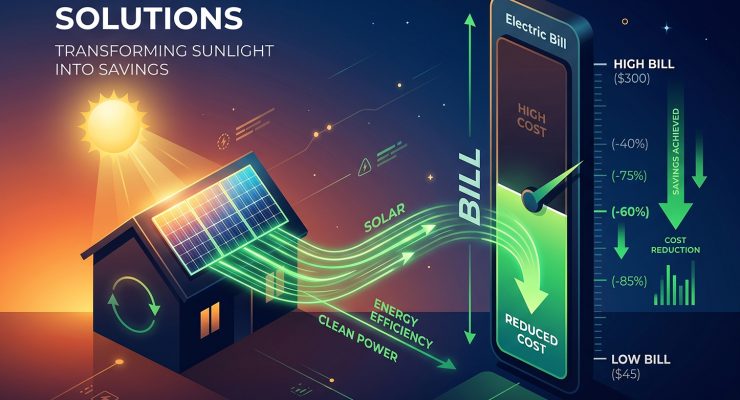
Most residential solar proposals contain one big number, projected savings, without the work that produced it. Solar electric bill savings are real, but they vary depending on where you live, how you use energy, and what your utility pays for excess power. This guide explains how that number is calculated and where most estimates go wrong.
A solar system does not simply subtract itself from your bill. It displaces electricity you would otherwise buy, and in most cases exports some power back to the grid at a rate your utility controls. Understanding those two revenue streams, and the factors that affect each, is the foundation of any honest savings estimate.
US Solar Savings at a Glance
How Solar Savings Actually Work
The Three Factors That Determine Solar Savings
Three variables drive almost everything. System size sets the ceiling on generation: a 10 kW array under ideal conditions produces roughly 10,000 to 14,000 kWh per year depending on location. Self-consumption rate determines how much of that generation displaces retail-priced grid electricity directly. Utility rate sets the value of every kWh displaced; a household paying $0.32 per kWh benefits twice as much from the same system as one paying $0.16.
Why Two Homes Can Save Very Different Amounts
Two identical systems installed on adjacent streets can produce savings that differ by 40 percent. Roof orientation matters: a south-facing array in the Northern Hemisphere generates 15 to 20 percent more than an east- or west-facing one. Shading from trees or chimneys makes it worse. Household energy patterns compound the difference further: a home occupied during daylight hours self-consumes far more solar than one empty until evening, which directly affects the financial split between full-retail-value self-consumption and discounted grid exports.
Average Solar Savings in the United States
Typical Monthly Electric Bill Reduction
The average residential solar system reduces monthly electricity costs by $100 to $200. The range reflects real variation: Arizona households paying high rates and running air conditioning year-round sit toward the top; cloudy northern households with modest bills sit toward the bottom.
Typical Annual Savings Range
Nationally, the realistic annual savings range is $1,200 to $2,500 for a properly sized system. These figures assume standard net metering and average electricity rate escalation. Neither is a ceiling. California homeowners with batteries and high TOU rates routinely exceed $3,000.
Lifetime Savings Over 25 Years
Solar panels carry standard warranties of 25 to 30 years, and cumulative savings over that span can reach $30,000 to $60,000 for most US households. That assumes electricity rates escalate at their historical average of 3 to 5 percent per year. Every year utility rates rise, the cash value of the solar energy the system produces grows.
How to Calculate Your Solar Savings Step by Step
Step 1: Find Your Annual Electricity Usage (kWh)
Start with total annual electricity consumption: pull twelve consecutive months of utility bills to find the total kWh figure. The average US household uses approximately 10,500 kWh per year, though this varies substantially with house size, climate, and whether the home runs gas or electric appliances.
Step 2: Determine Your Current Electricity Rate
Divide your total annual bill, minus fixed monthly connection fees, by total kWh consumed to find your true volumetric rate. This strips out the flat fees that solar cannot touch and isolates the portion of the bill that generation directly offsets.
Step 3: Estimate Solar System Production
Estimate production using the National Renewable Energy Laboratory’s free PVWatts tool. Enter your roof angle, orientation, and location to get annual kWh output per installed kilowatt. A 1 kW system in Phoenix generates roughly 1,900 kWh annually; the same system in Boston generates approximately 1,200 kWh. Multiply by your planned system size.
Step 4: Calculate Self-Consumption vs Grid Export
Map your daytime consumption against your production curve. If most appliance load runs at night, a larger share of solar production flows back to the grid at the utility’s export rate rather than displacing retail electricity. Households that shift loads to midday, or add battery storage, improve this ratio significantly.
Step 5: Apply Utility Rates and Net Metering Credits
Value self-consumed power at your full retail rate. Value exported power at your utility’s net metering or avoided-cost rate, which may be as low as 4 to 6 cents per kWh under reduced-compensation programmes. The formula: Annual Savings = (Self-Consumed Solar kWh x Retail Rate) + (Exported Solar kWh x Export Buyback Rate)
Solar System Size and Its Impact on Savings
How Many Solar Panels Do You Need?
System sizing starts with your target offset, not with the maximum your roof can fit. Most installers recommend sizing to 80 to 100 percent of annual consumption; oversizing beyond 100 percent adds cost without proportional savings in states that limit annual credits.
Small, Medium, and Large System Savings
A small system of 4 to 6 kW suits energy-efficient homes or properties with limited roof space, with annual savings typically between $600 and $1,200. A medium system of 7 to 10 kW matches the average US single-family home and generates $1,400 to $2,400 in annual savings. Large systems above 11 kW are for homes with electric HVAC, heated pools, or multiple EVs, where annual savings can exceed $3,000.
Why Oversizing Doesn’t Always Increase Savings
Oversizing does not proportionally increase savings under most modern utility frameworks. Many states now credit excess annual generation at avoided-cost rates rather than retail, and some cap annual credits entirely. A system producing 30 percent more than the home consumes will export that surplus at a fraction of the retail rate, extending the payback period without adding meaningful returns.
The table below shows typical annual generation and savings estimates by system size for a median US electricity rate.
| System Size | Best For | Typical Annual Output | Annual Savings Estimate |
|---|---|---|---|
| Small (4-6 kW) | Efficient homes, limited roof space | 5,000-8,000 kWh | $600-$1,200 |
| Medium (7-10 kW) | Average US single-family home | 9,000-13,000 kWh | $1,400-$2,400 |
| Large (11-15 kW) | Homes with EVs, HVAC, or pools | 13,000-20,000 kWh | $2,500-$3,500+ |
| Oversized (>15 kW) | Large properties; export-friendly states | 20,000+ kWh | Diminishing returns in most states |
Understanding Self-Consumption Rate
What Is Self-Consumption?
Self-consumption is the percentage of solar generation used by the home in real time, at the moment the panels produce it. A system with 30 percent self-consumption uses three in ten generated kWh directly; the remaining seven flow to the grid for export compensation.
Why Self-Consumed Solar Is More Valuable
Self-consumed solar is worth more than exported solar. Using a kWh on-site avoids buying one at full retail. Exporting that same kWh earns the utility’s buyback rate, which under reduced-compensation programmes like California’s NEM 3.0 can be 70 to 80 percent lower than retail. A system with 80 percent self-consumption under NEM 3.0 earns dramatically more than an identical system running at 30 percent.
How to Increase Self-Consumption
Standard homes without battery storage achieve 20 to 35 percent self-consumption because solar production peaks at midday when most homes are empty. Shifting heavy loads, including dishwashers, laundry, and pool pumps, to run between 10 AM and 2 PM captures more of that midday production. Charging electric vehicles during peak solar hours instead of overnight makes an even bigger difference. Battery storage can push self-consumption to 80 to 90 percent by storing surplus midday energy and dispatching it through the evening.
How Utility Rates Affect Solar Savings
High Electricity Rate vs Low Electricity Rate Comparison
The electricity rate is the single largest variable in any solar savings calculation. A California or Massachusetts household paying $0.32 per kWh gets twice the financial benefit from the same displaced kWh as a Louisiana or Washington household paying $0.13 per kWh. That gap compresses payback timelines: the high-rate homeowner recovers their system cost in six to eight years; the low-rate homeowner may take eleven to fourteen years.
Time-of-Use (TOU) Utility Plans
Time-of-use tariffs add complexity. Under TOU pricing, electricity costs vary by hour: cheap at midnight, expensive during the evening peak from 4 to 9 PM when solar production has already stopped. Solar alone does not capture those peak-hour savings. A battery that dispatches solar-charged power during the expensive evening window turns TOU pricing from a financial threat into an advantage.
Flat-Rate Plans and Demand Charges
Flat-rate plans are simpler: savings scale linearly with kWh offset, regardless of time of day. Demand charges, common in some commercial utilities and appearing in certain residential tariffs, are fees based on the single highest energy demand spike in any fifteen to thirty minute window in the billing period. Solar reduces demand charges only if the panels are generating at the moment of that spike.
How Electricity Rate Changes Solar Economics
Net Metering and Export Credits Explained
What Is Net Metering?
Net metering is the billing mechanism utilities use to credit solar owners for power fed back to the grid. Under full retail net metering, every exported kWh earns a credit equal to the retail purchase price, a clean one-to-one offset. This is the framework with the shortest payback periods and highest lifetime returns.
Reduced Export Compensation Programmes
Reduced-compensation programmes change the economics substantially. Under California’s NEM 3.0, avoided-cost export credits run roughly 4 to 6 cents per kWh against a retail rate exceeding 30 cents. A household exporting 60 percent of its generation under NEM 3.0 earns far less than it would have under the previous framework, which is why NEM 3.0 effectively makes battery storage the financially rational choice for new systems.
Example Solar Savings Calculations
Three scenarios show how rate environments and net metering policies determine actual savings. In a low-cost area at $0.13 per kWh with full retail net metering, an 8 kW system generating 11,000 kWh annually saves approximately $1,430 per year, with payback running eleven to thirteen years. In an average-cost area at $0.18 per kWh under full net metering, the same system saves approximately $1,980 annually with payback of seven to nine years. In a high-cost area at $0.32 per kWh with reduced export compensation and an 8 kW system paired with a home battery achieving 80 percent self-consumption, annual savings reach $3,100 or more with payback of six to eight years.
The comparison table below shows these three scenarios side by side.
| Metric | Low Cost Area | Average Cost Area | High Cost (with Battery) |
|---|---|---|---|
| Electricity Rate | $0.13 / kWh | $0.18 / kWh | $0.32 / kWh |
| Net Metering Type | Full Retail (1:1) | Full Retail (1:1) | Reduced Export |
| Annual Savings (8 kW) | $1,430 | $1,980 | $3,100+ |
| Estimated Payback | 11-13 Years | 7-9 Years | 6-8 Years |
Solar Panels vs Rising Electricity Prices
Residential electricity prices in the United States have risen at roughly 3 to 5 percent per year historically, driven by grid infrastructure investment and fuel cost volatility. Solar locks in a cost of approximately zero per kWh for the life of the system. Every year utility prices rise, the value of what the system produces grows.
A system saving $2,000 in year one saves approximately $2,700 in year ten and over $3,600 in year twenty under a conservative 3 percent annual rate escalation assumption. Estimates that ignore rate escalation consistently understate the long-term return. The compound effect across a 25-year system life is substantial.
Factors That Can Reduce Solar Savings
Five factors most often cause real-world savings to fall short of projections. Roof shading from trees, chimneys, or neighbouring structures reduces generation and, in string inverter systems, can drag down output across an entire array rather than just the shaded panels. Poor orientation, particularly due east or due west, reduces annual generation by 15 to 20 percent compared with an optimised south-facing installation.
Utility policy changes are the most unpredictable risk. Regulators in several states have moved customers from full retail net metering to reduced-compensation frameworks with little notice, changing the economics of systems sized under the previous rules. Rising fixed monthly connection fees, which solar cannot offset, erode savings in the same way. Honest installers acknowledge this regulatory risk; those projecting decades of static utility policy deserve scepticism.
Solar Battery Storage and Additional Savings
A home battery increases solar savings in specific circumstances. In regions with reduced net metering, poor export rates, or high time-of-use peak pricing, a battery storing surplus midday solar and dispatching it through the evening substantially improves the economics. Self-consumption rates that would otherwise run at 30 percent can reach 80 to 90 percent with proper battery integration, and moving from exporting at 5 cents to self-consuming at 30 cents per kWh changes the return profile.
Where utilities offer full retail net metering and flat-rate pricing, a battery adds resilience and backup power but contributes negligible incremental financial savings. The grid works as an unlimited virtual battery in that framework, crediting exports at full retail value and selling power back at the same price. Paying for a physical battery to replicate that function rarely produces positive returns on the battery investment alone. ToriChain’s guide to solar financing options covers how the method of purchasing or leasing a system alters the net savings and payback calculation substantially.
How to Estimate Your Personal Solar Savings Before Getting Quotes
Three pieces of information from your utility bill form the baseline for any savings estimate: total annual consumption in kWh, your current volumetric rate structure including any tiered pricing, and the fixed monthly connection fee that solar cannot displace. With those, the NREL PVWatts calculator provides free production estimates for any US address using only roof tilt and orientation as additional inputs.
Installer proposals deserve scrutiny on three specific assumptions. Utility rate inflation projections above 5 percent compound annual growth inflate long-term savings beyond any historically supportable basis. Assuming full retail net metering without verifying your specific utility’s current policy overstates export value. Hidden financing fees buried in loan principal add cost that savings projections frequently omit. Running your own baseline numbers before the first sales meeting lets you evaluate any proposal against an independent benchmark.
How to Calculate Your Solar Savings: 6 Steps
Pull 12 months of utility bills. US average is approximately 10,500 kWh per year
Divide annual bill (minus fixed fees) by total kWh consumed
Use NREL PVWatts with roof angle, orientation, and location data
Map daytime usage against production curve to find each share
Self-consumed kWh at retail; exported kWh at utility buyback rate
Annual Savings = (Self-Consumed x Retail Rate) + (Exported x Buyback Rate)
Frequently Asked Questions
How much can solar reduce my electricity bill?
Solar can reliably eliminate 80 to 100 percent of volumetric electricity charges for a properly sized system. Most homeowners still receive a minimal monthly bill for the utility’s fixed connection fee, which runs $10 to $30 in most markets and cannot be offset by generation.
Is solar worth it if electricity rates are low?
At rates below $0.12 per kWh, solar payback extends to twelve or more years without incentives. The 30 percent federal Residential Clean Energy Credit changes that materially by reducing upfront system cost by roughly $8,000 on a typical $27,000 installation. State rebates and local incentives can compress payback further.
Do solar savings increase over time?
Solar savings increase every year because the value of displaced electricity grows as utility rates rise. A system generating the same kilowatt-hours in year five saves more money than it did in year one, because those kilowatt-hours are worth more.
How long does it take for solar panels to pay for themselves?
The average US payback period runs seven to eleven years after the federal tax credit. After payback, the remaining fifteen to twenty years of system life generate savings with no offsetting capital cost. That is where most of the lifetime return actually comes from.
Final Takeaway
Solar electric bill savings depend on six variables: system size, local sun hours, electricity rate, self-consumption rate, utility export policy, and financing structure. No two households face the same combination. The homeowners who see the best returns understand their utility’s specific policies before signing anything, size their system to their consumption rather than to roof capacity, and treat self-consumption as the primary financial optimisation target.
The honest answer to how much solar can save is that it depends on those variables. Anyone unwilling to specify the assumptions behind a savings projection is giving you a number shaped by commission rather than analysis.
How Solar Savings Grow Over 25 Years (3% Rate Escalation)