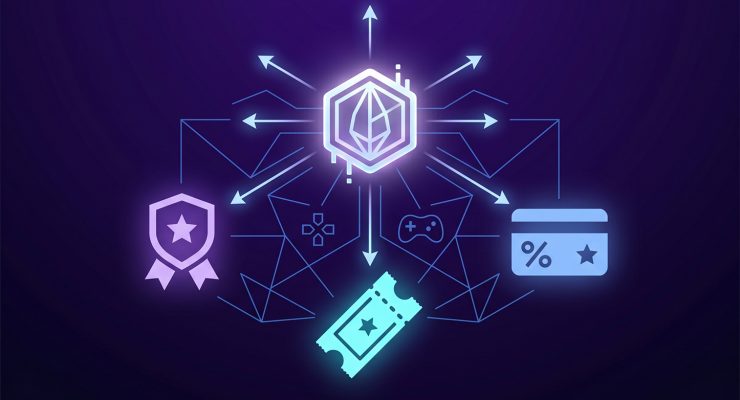
The speculative bubble has cleared, and what remains is more interesting than the hype suggested. Utility NFTs have quietly migrated from a curiosity at the edge of crypto markets into a functional layer inside mainstream commerce, powering systems that millions of consumers interact with daily without ever learning the mechanism. These tokens derive their value not from aesthetic rarity but from the rights, access, and rewards they grant the holder. The shift is structural, not cyclical.
Utility NFTs in 2026: Key Numbers at a Glance
What a Utility NFT Actually Is
A collectible NFT asks the holder to believe in its value. A utility NFT creates value directly: unlocking a venue entrance, updating its own metadata when a loyalty tier is crossed, or granting a software licence that can be resold without a customer-service call. The distinction matters because it changes the underlying economics entirely. Scarcity of supply drives collectible value; depth of function drives utility value.
The smart contract is the mechanism. Rights, eligibility criteria, and reward conditions are encoded at the point of minting and execute automatically when a wallet interacts with a qualifying system. No intermediary is required to verify whether a holder is entitled to early product access or a reserved conference seat. The blockchain handles verification in the background, and the user, increasingly, never sees the blockchain at all.
The table below compares the two models across the dimensions that determine long-term market staying power.
| Dimension | Collectible NFT | Utility NFT |
|---|---|---|
| Primary value driver | Visual rarity and speculative demand | Embedded rights and functional access |
| Revenue model for creator | Mint sales plus secondary royalties | Ongoing service revenue plus secondary royalties |
| Value after trend fades | Typically collapses with community interest | Persists as long as the utility remains active |
| Interoperability | Limited; value tied to originating community | Designed for cross-platform recognition |
| Primary audience in 2026 | Crypto-native collectors and speculators | Mainstream consumers, brands, and gaming studios |
Membership Tokens and Token-Gated Access
Perhaps the clearest illustration of utility over aesthetics is the membership token. A user connects a compatible wallet to a web platform; the platform reads the token and determines access level in under a second. Discord and Telegram bots can grant or revoke community roles in real time as tokens move between wallets. The administrative overhead of maintaining membership databases, expiry dates, and password resets collapses entirely.
For creators, the model offers something more valuable than revenue alone: a direct relationship with the audience, unmediated by any algorithm. A creator whose distribution depends on a centralised platform can see reach cut without warning. A creator whose audience holds membership tokens owns that connection directly. Secondary-market royalties, encoded at the point of minting, generate income each time a membership pass changes hands, a mechanic absent from every subscription model that preceded it.
Commercial brands have taken note. Luxury retailers, entertainment groups, and consumer goods companies have trialled membership token programmes offering early product access, invitation-only events, and tiered discounts. The administrative architecture is simpler than a traditional loyalty CRM, and the behavioural data held on public ledgers is richer and more difficult to game than anything a first-party cookie ever produced.
Event Ticketing and the End of the Stub
Ticket fraud costs the live events industry hundreds of millions of dollars annually, according to industry body INTIX. Counterfeit paper and PDF tickets, cloned QR codes, and opaque resale platforms have proven resistant to platform-level fixes for years. NFT-based ticketing addresses the problem at the source: a smart-contract ticket cannot be duplicated because its authenticity is verified against a public ledger that any scanner can query instantly.
The operational gains compound beyond fraud elimination. An NFT ticket can transform after the event into a commemorative collectible, a discount voucher for next year’s show, or a proof-of-attendance credential that persists on the holder’s digital profile indefinitely. Organisers can programme maximum resale price caps directly into the contract, limiting the scalping premium that has made some events economically inaccessible. Royalty splits on secondary sales route a percentage back to the artist automatically, without a clearing intermediary.
NFT Ticketing vs Traditional Ticketing
Loyalty Programmes Reimagined
The traditional loyalty point is a liability on a company’s balance sheet and an asset with no liquidity for the consumer. Points expire, cannot be transferred, and are stranded inside proprietary applications that consumers rarely open. Research from Bond Brand Loyalty indicates the average household holds membership in more than fourteen loyalty programmes while actively using fewer than half of them.
NFT loyalty tokens correct this by making the reward liquid. A high-tier status token at one coffee brand can, if the issuing companies partner accordingly, be recognised by an airline, a hotel group, or a co-branded retailer. The user carries rewards in a personal wallet rather than across fourteen siloed applications. Brands gain access to on-chain analytics that reveal not just purchase frequency but the full lifecycle of a loyalty token: how often it is accessed, whether it is being traded, and at what point holders disengage.
Gamification layers make the model stickier still. A token whose metadata updates visually as a holder climbs spending tiers creates a behavioural incentive that static point balances cannot match. Holders who stop frequenting a brand can sell their high-tier status to a new customer, transferring both the commercial relationship and its embedded value, a mechanic that traditional loyalty programmes cannot replicate under any circumstances.
Gaming and the Value of True Ownership
The gaming industry arrived at utility NFTs through a different door. Early play-to-earn models from 2021 and 2022 were widely criticised for prioritising token extraction over game quality; the market crash that followed reset expectations sharply. What emerged was a generation of studios that embedded digital ownership into genuine gameplay rather than treating speculative returns as the product itself.
The practical difference centres on permanence. A skin, weapon, or plot of virtual land held as an NFT exists in the player’s wallet independent of the game’s servers. If the studio closes, the asset survives. If the player stops playing, the asset can be sold. Open-market economies, where players trade directly with one another and the studio collects a creator fee on each transaction, generate revenue streams that are both more sustainable and better aligned with the player’s interests than the closed economies that preceded them.
The table below illustrates the practical differences between traditional in-game items and NFT-based equivalents across the features players value most.
| Feature | Traditional Game Asset | NFT Game Asset |
|---|---|---|
| Ownership | Held by the studio; revocable at any time | Held in player wallet; non-revocable |
| If the studio shuts down | Asset deleted with the server | Asset remains in the player’s wallet |
| Resale options | Prohibited or limited to official store | Open peer-to-peer market |
| Cross-game portability | Impossible | Possible across compatible titles |
| Creator revenue on resale | None | Automatic royalty via smart contract |
The Infrastructure Powering Utility NFTs in 2026
Three converging developments have made mass-market adoption viable. Layer-2 and Layer-3 rollups have driven transaction costs to fractions of a cent, making micro-rewards and high-frequency interactions economically rational for the first time. Account abstraction has eliminated seed phrases for most consumer applications: users create wallets via Google or Apple sign-in, and biometric prompts replace the private-key management that deterred adoption for years. Token-gating SDKs allow any developer working with Shopify or standard CMS platforms to add wallet-based verification without specialist blockchain knowledge.
The result is that the cryptographic layer has become, for most users, entirely invisible. A consumer connecting a digital membership card to a retail website may not know or care that the verification mechanism runs on an Ethereum rollup. Brands have similarly begun retiring the word “NFT” from consumer-facing communications; “digital passport” and “insider membership” are the preferred framings in 2026 marketing materials. Gas-fee sponsorship, where the brand pays network costs on behalf of the user, removes the last friction point most consumers would ever notice.
Risks Worth Naming
The maturation of the market has not eliminated the conditions that produced earlier failures. Regulatory uncertainty around tokens that carry financial characteristics remains live in most jurisdictions. A utility token structured to offer passive returns, or that appreciates primarily through secondary-market speculation, risks classification as a security under United States and European Union frameworks. As detailed in ToriChain’s analysis of the SEC’s shifting crypto enforcement posture, the evolving regulatory environment adds meaningful compliance complexity for any issuer operating across borders.
Smart contract vulnerabilities are a structural risk rather than an edge case. An exploit in a poorly audited loyalty or membership contract can compromise an entire user base simultaneously. Security audits by specialist firms are the industry standard, but they are costly and do not eliminate risk; the expanding attack surface of high-value utility ecosystems makes them targets of a different character from the speculative projects that preceded them.
The deeper risk is conceptual: utility washing. The history of the space includes numerous projects that launched tokens promising sustained real-world benefits and delivered nothing beyond a speculative asset backed by a white paper. Evaluating a utility NFT strategy requires the same discipline as evaluating any business proposition. If the underlying loyalty programme, access product, or game would not function without a blockchain, attaching one is unlikely to rescue it.
NFT Evolution: From Speculation to Utility (2021-2026)
What Comes After 2026
Industry Adoption of Utility NFTs in 2026
Source: ToriChain analysis, 2026 deployment data
The most durable trajectory points toward identity infrastructure. Non-transferable tokens, sometimes called soul-bound tokens, are being piloted as verifiable credentials for educational qualifications, professional licences, and age verification. The ability to prove, without revealing underlying personal data, that one holds a valid credential has obvious applications in regulated industries and on platforms contending with AI-generated identities at scale.
Interoperability between loyalty ecosystems is the commercial frontier. An open-standard wallet carrying a user’s accumulated status, rewards, and credentials across every brand relationship simultaneously is technically achievable on current infrastructure. The barrier is commercial: brands that built competitive advantage on proprietary data have limited incentive to open their reward ecosystems unless the network effects outweigh the cost. That calculus is shifting as consumer wallets become common and younger demographics treat portability as a baseline expectation rather than a differentiator.
Autonomous AI agents represent the strangest and most consequential variable on the horizon. Software agents that hold utility tokens to access APIs, rent computation, and manage subscriptions independently of human direction have moved from theoretical to operational in early 2026 deployments. An NFT infrastructure designed for human holders may need to accommodate non-human participants at scale before the decade ends. Nobody has priced that into their roadmap yet.
Utility NFTs succeed precisely where speculative NFTs failed: by tying value to something a holder can use rather than something a market can price. The infrastructure is now mature enough, and cheap enough, to underpin products that ordinary consumers interact with daily without knowing the mechanism. The question for brands, creators, and platforms is not whether to integrate programmable digital ownership but how quickly the operational benefits outrun the reputational residue of the earlier era. That residue is fading faster than most expected. The infrastructure will outlast the word that names it.