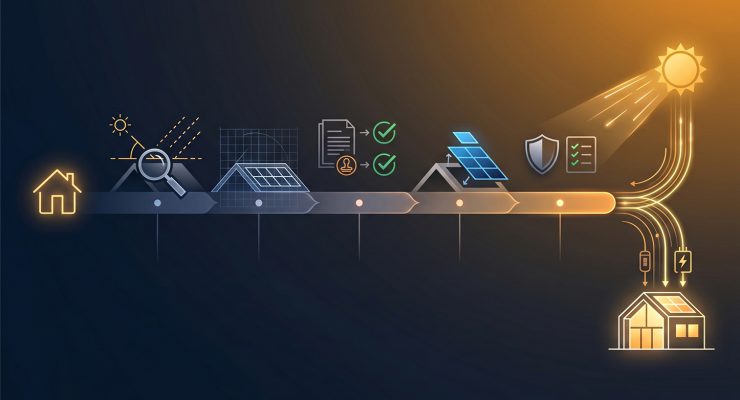
Most homeowners discover too late that the solar installation timeline is not primarily a construction project. The physical work, mounting panels, running conduit, and wiring the inverter system, takes between one and three days. The remaining two to four months are consumed by administrative stages: engineering plans, building permits, utility interconnection applications, municipal inspections, and the final Permission to Operate document that makes it legal to switch the system on. Understanding each stage before the contract is signed is the single most effective way to avoid the frustration that derails more solar projects than equipment costs ever do.
Going Solar: The Numbers That Define the Timeline
How Long Does the Solar Installation Process Really Take?
The entire process from contract signing to full grid-connected operation takes eight to sixteen weeks for the average residential installation in 2026. That range exists because two variables dominate the schedule: local jurisdiction processing speed and project complexity. A homeowner in a municipality that accepts digital permit applications and returns approvals within five business days will finish months ahead of an identical system permitted through an office running on paper submissions with a six-week review queue. Neither installer controls that variable; it is a function of local government infrastructure.
Project complexity adds independent time on top of jurisdiction speed. A straightforward grid-tied installation on a south-facing roof with a modern 200-amp electrical panel is the fastest possible scenario. Adding a battery storage system requires additional engineering, separate battery-specific permits in some jurisdictions, and more complex installation work. Structural roof reinforcement, needed when rafter spacing or decking condition falls below load requirements, adds contractor scheduling and inspection steps before the solar work can even begin. A main service panel upgrade, required when the existing panel cannot safely accept backfed solar power, adds a separate electrical permit and inspection cycle. Each element compounds the overall timeline independently of permit office speed.
Before You Sign: Preparing for a Solar Project (Days 1 to 7)
Before accepting a quote, retrieve the past twelve months of electricity bills and calculate total annual kilowatt-hour consumption. That figure is the primary input for system sizing, and designers who work from a single bill or a rough estimate frequently produce an array that leaves significant electricity costs in place. Factor in foreseeable load increases: an electric vehicle charger adds roughly 2,000 to 4,000 kilowatt-hours annually depending on driving patterns, and a heat pump conversion or new central air conditioning system adds a comparable amount. An undersized system that fails to offset the majority of electricity costs defeats the long-term economics of the investment.
Assess roof condition before any installer visits. A roof with fewer than fifteen years of remaining lifespan is typically replaced before solar installation, and reroofing with panels already mounted is expensive and logistically complex. South-facing and west-facing planes with less than 20 percent shade loss across a full year are the strongest candidates. Collect at least three competing quotes and compare price per watt, equipment brand quality, workmanship warranty length, and the installer’s NABCEP certification status. Homeowners financing with a solar loan rather than purchasing outright should note that the interest rate offered is directly tied to credit profile, as detailed in our breakdown of how the five credit score factors determine borrowing costs across every lending category. A higher score translates to a meaningfully lower rate over a ten-to-twenty-five-year solar loan term.
Site Assessment and Solar Evaluation (Week 1 to 2)
The site assessment is an in-person visit by a field surveyor collecting the precise technical measurements the engineering team requires to draft a valid permit set. The surveyor documents roof dimensions, rafter spacing, attic structural integrity, and the full electrical system configuration, including the main service panel’s amperage rating and the circuit breaker manufacturer. Certain panel brands with documented safety histories, including some Zinsco and Federal Pacific models, require mandatory replacement before any solar connection is permitted under current electrical codes. Identifying that early prevents a costly mid-project delay.
Shading analysis uses specialised instruments, including the Solmetric SunEye tool or digital 3D modelling software, to calculate the solar access percentage across the designated roof planes throughout the year. A south-facing plane with clear sky access for six or more peak sun hours daily is the strongest candidate. East and west-facing planes are viable but produce approximately fifteen to twenty percent less annually than an equivalent south installation. The homeowner’s obligation at this stage is access: unobstructed entry to the electrical panel, the attic, and the full roof perimeter. Providing documentation of recent roof repairs or the roof installation date in advance reduces follow-up requests that delay design work.
Solar System Design and Engineering (Week 2 to 4)
Engineers convert the field survey data into a Computer-Aided Design (CAD) blueprint specifying every panel’s position in compliance with local fire code setback requirements, which mandate clear access pathways along roof ridges, valleys, and eaves for emergency responders. The design maps all wire run paths, conduit routes, inverter mounting location, disconnect positions, and the rapid-shutdown safety switch location required under the 2020 National Electrical Code. Production modelling software, primarily Aurora Solar or PVsyst in the residential market, calculates a guaranteed year-one kilowatt-hour output based on shading measurements, equipment specifications, and local historical solar irradiance data.
Battery storage projects require a load profiling step: the engineer identifies which critical appliances the system must keep operational during a grid outage, including refrigerators, medical devices, and well pumps, and sizes the battery bank accordingly. Common residential options include the Tesla Powerwall 3 and Enphase IQ Battery 5P, each requiring specific placement and ventilation conditions. Before submission to the building department, many jurisdictions require a licensed Professional Engineer to formally review and stamp both the structural and electrical drawings. That PE stamp is what municipal plan reviewers rely on to confirm the design meets code requirements without performing an independent engineering analysis of their own.
Permits and Utility Applications (Week 3 to 8)
The installer submits the stamped engineering plans to the local building department, requesting the building and electrical permits that confirm the design complies with local and national codes. Simultaneously, a separate interconnection application goes to the electric utility, formally requesting permission to connect the solar generator to the distribution grid. The utility’s engineering team reviews whether the local transformer and neighbourhood lines can handle the reverse power flow the system would produce during peak generation. Both reviews run in parallel, and the longer of the two typically determines when the installer can order equipment.
Homeowners in managed communities face a third parallel process: HOA architectural review board approval. Most states have Solar Rights Acts that prevent homeowners associations from outright banning panels, though associations retain the authority to require reasonable aesthetic modifications such as panel alignment or conduit colour-matching to the roofline. Submitting the installer’s stamped engineered blueprints rather than a rough sketch dramatically accelerates HOA committee timelines. The most common permit delay source is documentation error: a missing PE stamp, a property address that does not exactly match the utility account, or an incorrect parcel number triggers a rejection that adds two to four weeks to the process.
Equipment Ordering and Project Scheduling (Week 4 to 8)
Equipment is ordered once the building permit is approved or is confirmed to be in the final stage of review. Ordering before permit approval creates a substitution risk: if a specific panel model goes on backorder, any replacement must match the specifications in the approved permit drawings exactly. A material change to the approved design requires a permit amendment that adds processing time. Mainstream residential equipment from Enphase, REC, Qcells, and Tesla is typically held in regional distributor inventory and arrives within two to five business days of release. Specialised high-efficiency bifacial panels, niche aesthetic modules, or large multi-unit battery configurations may carry two to four week shipping lead times.
Once equipment is confirmed in stock and permits are in hand, the project manager schedules the installation window. Installation dates remain flexible until approximately 48 hours before the crew arrives: severe rain, snow, or high winds delay rooftop work for safety reasons. A weather-related postponement typically shifts the crew to the following week rather than creating a multi-week gap, because experienced installers maintain rolling schedules specifically to accommodate weather flexibility.
Solar Installation: Stage-by-Stage Timeline
Solar Panel Installation Day (1 to 3 Days)
The installation crew arrives with all racking components, solar modules, inverter hardware, conduit, and electrical materials staged on a truck. Before ascending to the roof, the team installs fall protection anchors and rigging around the perimeter. Racking begins with locating the roof rafters from the attic or with magnetic stud-finding tools on the roof deck, drilling and waterproofing L-foot flashing attachments directly into the structural rafters at the engineered spacing, and mounting aluminium rails across those L-feet. Solar panels are hoisted to the roof in groups, seated into the rail channels, and clamped firmly with end and mid clamps rated for the local wind and snow loads specified in the structural design.
Electrical work proceeds in parallel with rooftop activity on multi-person crews. Conduit is routed down an exterior wall to the service area, where the solar subpanel, generation meter, and inverter are installed and wired. Microinverter systems mount a small inverter underneath each panel on the racking rail; string inverter systems use a single unit secured to an exterior wall near the main panel. The rapid-shutdown safety switch, required by the 2020 National Electrical Code for all new residential installations, is mounted in a visible location for emergency responder access. A planned power outage of two to four hours is required when the electrical team connects the solar circuit to the main breaker panel. This shutdown is scheduled in advance and is not hazardous to appliances when they are powered off beforehand.
Inspection and Approval Process (Week 6 to 10)
Once installation is complete, the installer notifies the local building department and schedules a municipal inspection. A building or electrical inspector visits the property to verify that the installed system matches the approved permitted drawings in every material respect and complies with applicable provisions of the National Electrical Code. The inspector checks conduit support spacing, system grounding, disconnect and inverter labelling, and functional confirmation of the rapid-shutdown system’s operation.
The majority of first-time inspections pass without required corrections. When deficiencies are identified, they are almost always minor: a missing safety placard, a conduit support bracket at slightly more than the code-maximum spacing, or a ground conductor label requiring clarification. The installer corrects these items within a few days and schedules a re-inspection at no cost to the homeowner. A passed inspection results in the inspector signing the building permit card, formally closing the construction phase of the project. The signed permit documentation is forwarded immediately to the electric utility, which triggers the utility’s own final review and Permission to Operate process.
Utility Interconnection and Permission to Operate (Week 7 to 12)
The interconnection agreement is the legal instrument that authorises bidirectional electricity flow between the solar system and the public distribution grid. Without it, the system cannot legally operate regardless of whether the hardware is fully functional and inspected. The utility processes the passed inspection documentation and either dispatches a technician for a brief on-site verification or completes a remote review depending on local procedures and system specifications. Processing times range from two days in utility districts with dedicated solar interconnection teams to four weeks in regions with limited staffing.
Where the existing meter is a standard single-directional model, the utility replaces it with a bidirectional smart meter capable of recording both power imported from the grid and surplus solar generation exported to it. Net Energy Metering activates simultaneously: the utility configures the billing account to credit the homeowner for excess kilowatt-hours delivered to the grid at the applicable rate. In markets operating under NEM 3.0 structures, including California, export credits are calculated on a time-of-use basis rather than a flat rate, meaning the value of exported power varies by the hour it is produced and consumed. The utility then issues the Permission to Operate document. Activating the solar system before this document is received can cause exported solar production to be recorded as grid consumption rather than as an export credit, a billing error that is difficult to reverse retroactively.
System Activation and First Day of Solar Production
Activation follows the installer’s written startup sequence: engage the main solar breaker inside the electrical panel, turn on the exterior AC disconnect switch, and activate the inverter in the manufacturer-specified order. The inverter initialises over 30 to 90 seconds, cycling through a connection verification process before displaying a steady green indicator that confirms a stable grid synchronisation. On microinverter systems, individual panel indicators sequence on over the following few minutes as each unit completes its own startup check.
The monitoring application, most commonly Enphase Enlighten, the Tesla app, or the SolarEdge platform depending on the inverter brand, populates a real-time production feed within minutes. On a clear day the production graph shows a smooth bell-shaped curve peaking at or near solar noon. Individual panel-level monitoring on microinverter systems allows the homeowner to confirm that every module is generating power within the expected range, immediately identifying any localised hardware or wiring issue before it silently reduces production for weeks. The first utility bill after activation should include net metering line items reflecting export credits. Verifying those items are active and accurate is the final confirmation that the billing configuration was completed correctly.
The Most Common Solar Installation Delays and How to Avoid Them
The large majority of solar project delays are administrative and preventable. Most originate in documentation or infrastructure failures that experienced installers eliminate before they occur. The table below identifies the six most common delay categories, their root causes, and the most effective prevention strategy for each.
| Delay Type | Root Cause | How to Prevent It |
|---|---|---|
| Permit processing backlog | Municipal review queue or incomplete first submission | Choose an installer with digital submission experience and established local permit office relationships |
| Roof repairs required | Hidden structural rot or insufficient remaining roof life discovered at survey | Require a physical attic inspection before signing; do not rely solely on satellite imagery quotes |
| Electrical panel upgrade needed | Existing 100-amp panel or flagged hazardous brand cannot accept solar backfeed | Request a full panel brand and amperage evaluation as part of the initial site assessment |
| Equipment backorder | Specific panel model, advanced battery, or inverter temporarily out of stock | Add acceptable equivalent substitution language to the contract before signing |
| HOA processing delay | Lengthy architectural review committee timeline | Submit stamped engineered plans early; reference your state’s Solar Rights Act in the application |
| Documentation mismatch | Name or address on contract differs from official utility account records | Verify every detail on the solar contract exactly matches the spelling on your utility bill |
Homeowner Checklist: What You Need to Do at Each Stage
Before installation begins, collect twelve months of utility bills and hand them to the design team. Trim any trees or branches casting shade on the roof planes identified in the site assessment. Obtain formal written HOA approval using the installer’s engineered blueprints before the permit is submitted: a retroactive HOA dispute after permit approval creates significant complications that delay an otherwise complete application. Verify that every detail on the solar contract matches the official name and address on your electric utility account, including punctuation and suite numbers.
During the installation period, clear all vehicles from the driveway and move outdoor furniture away from the roof perimeter before the crew arrives. Keep children and pets safely indoors throughout the rooftop construction period. Ensure the electrical team has unobstructed access to the main breaker panel, the garage, and the utility room where the inverter and subpanel will be mounted. Under no circumstances should any solar-related breaker be switched on independently, even briefly, before the municipal inspection has passed and the installer has confirmed the system is cleared for its formal test sequence.
After the inspection sign-off but before the PTO arrives, confirm with your installer that the passed inspection documentation has been submitted to the utility. Check your utility’s online account portal to verify your account is flagged as pending a solar interconnection change. Once the system goes live, download the monitoring application, configure automated daily production alerts, and store all paid invoices and permit documentation in a designated folder. That file is the source record for the federal Residential Clean Energy Credit filing, and its completeness determines the tax credit amount you can claim.
Realistic Solar Installation Timeline: By Project Type
The realistic range across installation categories spans from four weeks in the most favourable conditions to eighteen weeks or more for complex projects in slow jurisdictions. The table below shows estimated timelines by project type. The large majority of standard residential installations in average-speed jurisdictions fall within the eight-to-twelve-week band.
| Project Type | Estimated Timeline | Key Drivers |
|---|---|---|
| Fast-Track | 4 to 6 weeks | Digital municipal permitting, no HOA, modern 200A panel, south-facing roof, standard grid-tied system |
| Average Residential | 8 to 12 weeks | Standard municipal and utility review times, minor HOA process, straightforward roof layout and system design |
| Complex with Storage or Upgrades | 12 to 18+ weeks | Panel upgrade, structural roof reinforcement, multi-unit battery storage engineering, slow-jurisdiction manual permitting |
Where Your Solar Timeline Actually Goes
~50%
~20%
~15%
~10%
~5%
Key Takeaways: What First-Time Solar Buyers Should Expect From Start to Finish
Three conclusions define the first-time solar experience. Physical construction is the fastest part of the project by a wide margin. The weeks of waiting are spent in permit offices and utility processing queues, not on the roof. Plan around an eight-to-twelve-week standard solar installation timeline and treat anything faster as a bonus rather than an expectation. A quality installer manages the administrative complexity: permitting, utility engineering applications, inspection scheduling, and PTO coordination are part of the service. The homeowner’s role is primarily providing access, reviewing designs for aesthetic preferences, and ensuring documentation matches utility records precisely. Third, the Permission to Operate document is a legal authorisation, not a formality. Operating the system before it arrives creates billing complications that are substantially harder to correct after the fact than to avoid by waiting the final few days.
Solar Installer: Green Flags vs Red Flags
The solar installation timeline rewards patience at the administrative stages and decisiveness at the preparation stages. Homeowners who invest time in thorough pre-contract diligence, including an accurate site assessment, a verified roof condition, and a contract that specifies acceptable equipment substitutions, consistently reach Permission to Operate faster than those who rush the early stages and encounter correctable but time-consuming surprises later. ■